
Baykar’s Kizilelma is widely seen as the platform that takes Türkiye from the SİHA era into the age of unmanned combat aircraft (UCAVs).
After range and weapons load, one technical question keeps coming back:
“What is Kizilelma’s RCS value – how stealthy is this aircraft on radar?”
In this article we unpack Kizilelma’s RCS (radar cross section) in simple terms and clarify the difference between “low observable” and “full stealth”.
1. What is RCS (Radar Cross Section)?
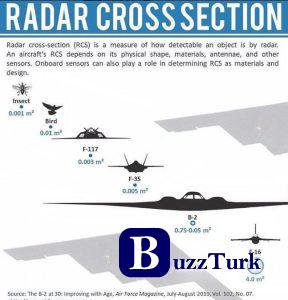
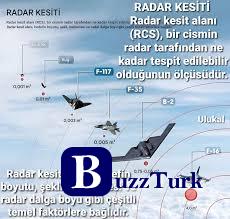
RCS describes how large an aircraft appears on a radar screen.
- Technically it is expressed as an area in square metres.
- The higher the RCS, the “bigger” the target looks to radar.
- The lower the RCS, the smaller and harder it is to detect and track.
In simplified terms:
- A big, angular aircraft = a large metal object for radar.
- A carefully shaped fuselage with angled surfaces and treated edges = a smaller shadow on radar.
So when we talk about Kizilelma’s RCS, we are really talking about the size of this unmanned combat aircraft’s radar shadow.
2. Low observable ≠ Full stealth
Important distinction:
- Full stealth:
Fighters like the F-22/F-35 family, where almost every design detail is optimised around radar signature, weapons are mostly internal and operating costs are very high. - Low observable:
Aircraft that significantly reduce radar signature, but are not locked into the extreme constraints of pure stealth. They aim for a balance between survivability and cost / mission flexibility.
For Kizilelma, it is more accurate to speak of a:
“Low observable unmanned combat aircraft”
rather than a classic stealth fighter. The goal is not to be completely invisible, but to be seen later and tracked with more difficulty than conventional aircraft or MALE drones.
3. Has Kizilelma’s RCS been disclosed?
So far:
- There is no official table saying “Kizilelma RCS = X m²”.
- Public comments focus on “low radar signature”, “reduced radar cross section”, “low observable design”.
- Any exact numbers you see online are best treated as estimates or speculation.
Instead of chasing a single value, it is more useful to look at the design philosophy:
- Overall shape,
- Wing–fuselage blending,
- Inlets and tail layout,
- Use of coatings and materials,
all point towards a reduction of radar cross section compared with traditional designs.
4. How can Kizilelma’s radar signature be reduced?
Kizilelma can reduce its RCS using several principles:
- Geometry
- Replacing sharp, right-angle corners with carefully angled surfaces,
- Deflecting radar waves away from the radar source rather than straight back at it.
- Materials and coatings
- Using materials and coatings that absorb or attenuate radar energy in sensitive areas,
- Smoothing panel joints, sensor openings and edges to avoid strong radar “hot spots”.
- Weapon configuration
- Any external pod, bomb or missile increases RCS.
- Depending on the mission, planners can choose “less signature, less payload” or “more payload, more signature”.
As a result, compared to classic SİHAs, Kizilelma aims for a much lower radar signature, without being constrained as heavily as a first-line stealth fighter.
5. Low RCS + MURAD AESA + GOKDOGAN: a system effect
Kizilelma is more than just a low-RCS airframe; it is part of a combined system:
- Low RCS (Kizilelma RCS):
Makes the aircraft harder to detect and track for enemy radars. - MURAD AESA radar:
Provides high-resolution tracking, the ability to look at multiple targets at once and advanced electronic warfare modes. - GOKDOGAN air-to-air missile:
Allows beyond-visual-range (BVR) engagements.
Put together, this means:
A platform that is detected later,
detects its targets earlier,
and uses BVR missiles to exploit that advantage.
The lower Kizilelma’s radar signature, the more powerful this MURAD + GOKDOGAN combination becomes.
6. Focus on the concept, not a single number
In short:
- There is no single verified number for Kizilelma’s RCS in the public domain.
- Officially, Kizilelma is best described as a low observable unmanned combat aircraft.
- The aim is to be detected later than conventional fighters and much later than classic MALE drones.
So instead of asking:
“What is Kizilelma’s exact RCS in square metres?”
it is more meaningful to ask:
“How does Kizilelma’s reduced radar signature change the way it can be used in combat?”
With TB2 and Akinci, Türkiye gained experience in using armed drones in real operations.
With Kizilelma’s RCS, the MURAD AESA radar and the GOKDOGAN missile, that experience is now being extended into the air-to-air domain.
BuzzTurk will continue to follow this story – from range and RCS to sensors and weapons – to map out the full tactical picture of Türkiye’s new UCAV era.