
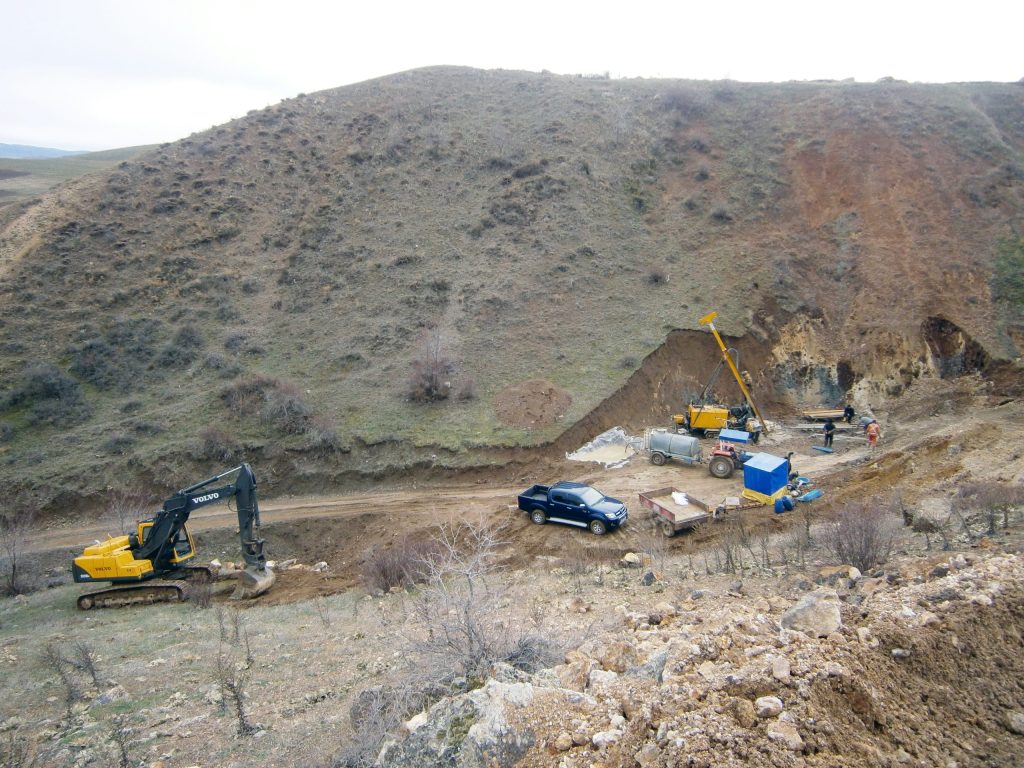
Was 4 Billion Dollars’ Worth of Gold Really Found in Yozgat?
Turkey has been making headlines in recent years with energy and mining discoveries. This time, the spotlight is on the Central Anatolian province of Yozgat. Many news outlets ran with the eye-catching headline:
“4 billion dollars’ worth of gold found in Yozgat.”
The announcement comes from Ahlatcı Holding, which reported that geological studies and drilling at its licensed site in the Sarıkaya district of Yozgat point to a potential of around 927,000 ounces of gold – roughly 28–30 tonnes – with an estimated value of about 4 billion USD at current prices.
But does that mean there is already a 4-billion-dollar treasure sitting in a vault? Not quite. Let’s break it down.
What exactly has been announced?
According to the company’s statement, the work in Yozgat–Sarıkaya is based on:
- A series of 56 drill holes,
- Detailed geological mapping and modelling,
- An independent report prepared in line with UMREK-2023 standards (Turkey’s public reporting code for mineral resources).
This report talks about:
- An estimated 41+ million tonnes of potential ore,
- With an average grade of about 0.70 g/t (grams per tonne) of gold,
- Corresponding to roughly 927,000 ounces of gold in place.
These figures are not pulled out of thin air, but they are still geological and statistical estimates based on the existing drilling grid, not the final, fully proven reserve.
Found or just “potential”?
Here is the key distinction that the headlines often skip:
- In technical terms, the report describes an “exploration target / potential mineralized body”,
- It does not yet declare a fully “proven and probable reserve” that is ready to be mined.
The usual path in mining looks like this:
- Early exploration & first drillings – identify a promising zone.
- Detailed drilling & 3D modelling – define a potential mineralized body (this is where Yozgat stands now).
- Tighter drilling + feasibility studies – upgrade part of that potential into measured and indicated resources, then into proven/probable reserves.
- Investment & production – building or expanding a mine, starting commercial extraction and processing.
So yes, there is serious geological potential in Yozgat–Sarıkaya. But no, it is not yet a fully confirmed, shovel-ready 4-billion-dollar gold reserve.
How do they arrive at “4 billion dollars”?
The 4-billion number is essentially a theoretical calculation:
- Estimated gold in the ground: ~927,000 ounces,
- Multiplied by the current gold price per ounce,
- Gives you a notional value in the 4-billion-USD range.
However:
- This is a gross in-situ value,
- It does not subtract:
- Capital expenditure (CAPEX) to build or expand the mine and processing plant,
- Operating costs (OPEX: energy, labour, chemicals, maintenance, etc.),
- Royalties, taxes and financing costs.
On top of that, the ore will be mined over many years, not in a single day, and gold prices will move up and down along the way. In short, the 4-billion figure is the size of the theoretical “cake,” not the net profit.
What does it mean for Turkey?
On a global scale, an extra 30 tonnes of gold is not a game changer:
- The total amount of gold mined in human history is estimated at over 200,000 tonnes,
- So this project is a tiny fraction of world supply.
But for Turkey, the picture is more interesting:
- Turkey has been working to increase its domestic gold production for years,
- The country imports significant amounts of gold, which weighs on the current account balance,
- Every extra tonne of gold produced inside the country is, in theory, one less tonne that has to be imported with hard currency.
So while this discovery is not big enough to move global gold prices, it can contribute, over time, to improving Turkey’s own gold balance and slightly reducing its dependence on imported bullion.
What does it mean for Yozgat and Sarıkaya?
The real day-to-day impact is likely to be felt most strongly at the local level.
If the project progresses from exploration to full-scale mining:
- The operation could create hundreds of direct jobs for miners, engineers, technicians and administrative staff,
- Plus thousands of indirect jobs in:
- Transport and logistics,
- Accommodation and catering,
- Equipment, maintenance and security,
- Local retail and services.
In addition:
- Roads, power lines, water and communications infrastructure around the mine site will likely be upgraded,
- Yozgat and especially Sarıkaya could develop a new economic identity as a regional mining hub.
Of course, there is another side to the story: environmental impact. Gold mining is among the most environmentally sensitive industries. In an area where agriculture and livestock farming also matter, the balance between economic gains and environmental costs will have to be managed with great care.
Will it move the gold price or our jewellery bills?
Short answer: very unlikely.
- In the context of the global bullion market, 30 tonnes of potential new supply is small,
- Gold prices are primarily driven by:
- Interest rates and bond yields,
- The strength of the US dollar,
- Geopolitical risk,
- Central bank buying and selling.
So you should not expect this project alone to suddenly make jewellery or investment gold dramatically cheaper in the short term. Its contribution is more about Turkey’s long-term gold strategy than about today’s shop prices.
From an investor’s point of view
Naturally, many investors look at this kind of news through the lens of the stock market:
- Ahlatcı Holding is a major player in jewellery, refining and mining,
- The Sarıkaya project adds a strong narrative to the group’s mining ambitions,
- But at this stage, we are still talking about exploration potential, not a fully de-risked, producing mine.
In the short term, such headlines can fuel speculative moves in related shares. In the long term, however, what really matters is:
- How much of the potential can be converted into economically mineable reserves,
- How large the investment will be, and over what timeline,
- What the production costs per ounce will look like,
- And where gold prices will trade through the life of the mine.
In other words, it is a story to follow, not a one-line “get rich quick” signal.
Conclusion: Impressive headline, complex reality
The “4 billion dollars of gold found in Yozgat” headline is powerful and attention-grabbing. But behind that headline lies:
- Years of geological exploration and drilling,
- A careful estimate of potential ore and contained metal,
- A long path from exploration target to proven reserve and then to production,
- And a delicate balance between economic development and environmental responsibility.
For Yozgat and Sarıkaya, this discovery represents a significant economic opportunity. Whether that opportunity turns into real, sustainable prosperity will depend on the decisions made in the coming years – in boardrooms, in government offices and on the ground at the mine site itself.