
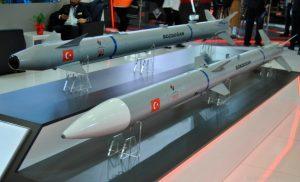
Türkiye’s first beyond-visual-range (BVR) air-to-air missile Gokdogan has now moved from “project slide” to real-world weapon system status.
In a live-fire trial over the Black Sea, the Bayraktar Kizilelma unmanned fighter used the Gokdogan missile to destroy a jet-powered aerial target from BVR distance – marking the first time in history that:
An uncrewed combat aircraft has shot down a jet target with a BVR air-to-air missile.
So what exactly is Gokdogan and what does the Kizilelma test change for Türkiye’s air combat doctrine?
1. What is Gokdogan?
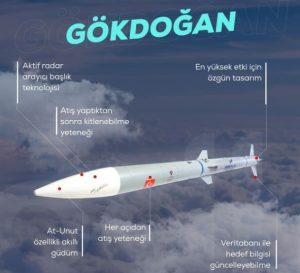
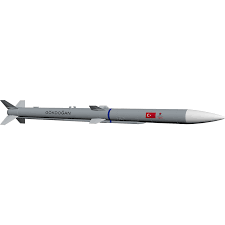
Gokdogan is a beyond-visual-range air-to-air missile developed by TUBITAK SAGE. It sits in the same class as the AIM-120 AMRAAM family and is designed as a national BVR solution.
In short:
- Class: BVR air-to-air missile
- User: Turkish Air Force
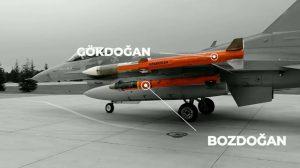
- Platforms: F-16, in the future Kaan, Kizilelma and potentially other fighters/UCAVs
- Motor: solid-fuel rocket motor
- Guidance: active radar seeker + data link (inertial guidance with mid-course updates, then active radar in the terminal phase)
- Role: national replacement / alternative for imported BVR missiles
In practice, Gokdogan gives the Turkish Air Force the ability to:
Launch at targets without visual contact, directly from the radar screen, at medium-to-long range using a fully indigenous weapon.
2. Where does it sit in the BOZDOGAN – GOKDOGAN – GOKHAN family?
Türkiye’s air-to-air missile roadmap can be summarised as:
- BOZDOGAN → within-visual-range (WVR) air-to-air missile
- GOKDOGAN → beyond-visual-range (BVR) air-to-air missile
- GOKHAN → ramjet-powered, longer-range BVR concept (Meteor-like class)
Within this trio, Gokdogan’s job is clear:
- Fired from F-16s, Kaan and Kizilelma
- At medium/long range
- Using a “fire-and-forget, with mid-course updates” concept
It is the main weapon of the first engagement layer in air combat.
3. Range and target set
Open sources place Gokdogan’s effective range in the 65+ km BVR class, with some references mentioning distances greater than this baseline.
Typical targets:
- Fighter aircraft
- Jet-powered target drones / aerial targets
- Large transport and tanker aircraft
But BVR range is not just about a number on paper. The key factors are:
- The active radar seeker in the final phase, so the missile can see and home on the target itself
- Data link updates during flight, allowing course corrections as the tactical picture changes
- ECCM features to fight through jamming and decoys
This makes Gokdogan suitable both for classic F-16 air patrols and for BVR engagements launched from unmanned platforms.
4. What exactly happened in the Kizilelma test?
The Kizilelma–Gokdogan BVR shot was carried out over the Black Sea. The scenario, simplified:
- Bayraktar Kizilelma used its MURAD AESA radar to detect a jet-powered aerial target at BVR range.
- Kizilelma locked onto the target and calculated an engagement solution for the Gokdogan missile under its wing.
- Via data link, Kizilelma sent mid-course guidance updates to Gokdogan during flight.
- Gokdogan left the rail, flew the mid-course phase using inertial guidance plus updates, then switched to its own active radar seeker in the terminal phase.
- The jet-powered target was successfully destroyed – and the shot was recorded as a world first: a jet target killed by a BVR missile launched from an unmanned combat aircraft.
This test was not just a “missile firing”; it delivered a triple message:
- Kizilelma is ready as a combat platform (envelope, launch, data link).
- MURAD AESA is mature enough to support real BVR shots.
- Gokdogan has moved from project to operational capability.
5. How is this different from classic F-16 BVR shots?
F-16s firing AIM-120-class BVR missiles is nothing new. What is new here is:
- The platform is an uncrewed jet-powered combat aircraft, not a slow MALE drone.
- The target is a jet-powered aircraft, not a simple drone.
- The radar and missile are part of a national, integrated ecosystem.
This opens the door to future concepts where:
The Turkish Air Force uses mixed manned–unmanned formations,
with F-16s and Kaan fighters working together with Kizilelma wingmen sharing sensors and weapons.
In that picture:
- F-16s can offload some risk and radar workload.
- Kizilelmas can move forward as “spearhead” shooters and sensors.
- Gokdogan becomes the shared BVR weapon that both manned and unmanned platforms can fire.
6. Gokdogan in the “loyal wingman” doctrine
Kizilelma is often described as a “loyal wingman” candidate – an unmanned aircraft flying in support of manned fighters.
In such a concept:
- The unmanned aircraft (Kizilelma) flies further forward into the high-risk area.
- The manned fighter (F-16 or later Kaan) stays further back in a safer zone.
- Sensors and weapons are distributed across the formation.
Gokdogan’s role here:
- It is qualified for launch from both F-16 and Kizilelma (and later Kaan).
- Tactically, it becomes the common BVR punch of the whole manned–unmanned team.
In other words:
No matter which platform fires the missile,
Gokdogan is the weapon that confuses the enemy and breaks the engagement from stand-off range.
7. Conclusion: A national step into the BVR era
To sum up:
- Gokdogan is Türkiye’s indigenous BVR air-to-air missile with an active radar seeker and mid-course data link.
- In the Kizilelma test, it enabled a world-first BVR kill from an unmanned combat aircraft against a jet target.
- Deployed on F-16, Kizilelma and later Kaan, it becomes:
- The core of national BVR capability,
- A bridge bringing air-to-air combat into the unmanned domain,
- The middle tier of the Bozdogan–Gokdogan–Gokhan missile family.
For BuzzTurk’s Defence & Aerospace readers, the key takeaway is simple:
With Gokdogan, Türkiye has taken a decisive step from imported BVR missiles to a homegrown air-to-air weapon, designed to work hand-in-hand with its new generation of manned and unmanned fighters.